
2017 Latest Design Special Wax in Agriculture and Forestry Wholesale to Uruguay
Short Description:
Product Detail
Product Tags
2017 Latest Design Special Wax in Agriculture and Forestry Wholesale to Uruguay Detail:
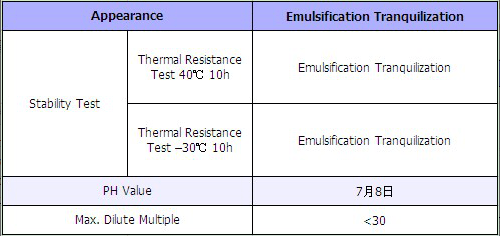
(1)YNE4 Series Special Molding Moisturized Wax for Fruit Trees
In order to protect fruit trees and shrubs from desiccation during winter dormancy or transportation or to keep moisture in summer drought, Special Molding Moisturized Wax is spayed on the surface of trees, forming the protecting film in surface of trees. The film has some adequate micro pore that could efficiently reduce the losses of moisture in the surface of the trees, and it simultaneously ensures physiological respiration of the trees.
(2) YNE5 Series Special Preventing Frostbite Wax for Trees
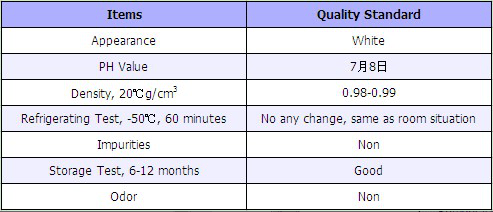
(3) In large northern areas of our country, the winter season is severe cold and the spring season is more heavy windy.
The early winter and the late spring’s frost are quite disadvantage to young plant, the weather is particularly abnormal coldness after spring comes, and frequently injures these trees. As a result young plant is cold death. YNE5 Series Special Preventing Frostbite Wax for Trees not only has anti-freezing effect on trees but also well effect on anti-sprouting etc. Spraying on branches and leaves of trees can make exuberant growth of foliage.
Product detail pictures:

We are going to dedicate ourselves to providing our esteemed buyers together with the most enthusiastically thoughtful products and services for 2017 Latest Design Special Wax in Agriculture and Forestry Wholesale to Uruguay, The product will supply to all over the world, such as: Brunei, Dubai, Mexico, We adhere to client 1st, top quality 1st, continuous improvement, mutual advantage and win-win principles. When cooperation together with the customer, we provide shoppers with the highest high-quality of service. Established good business relations using the Zimbabwe buyer inside the business, we've got established own brand and reputation. At the identical time, wholeheartedly welcome new and old prospects to our company to go to and negotiate small business.
Loading Repeatability is ±0.5%
IAl’s Servo Press has superior loading accuracy which contributes to increased processing quality.
Variety of Product Groups: 8 Models in the Lineup
The applicable thrust is from 2kg to 5t (50,000N). Ample lineup is prepared.
Supports Traceability
Without using an external load cell, encoder or PLC, processing history data such as positioning (mm), load (N), and pressure results can be output to a computer or dedicated display unit.
Simple Setting
It only requires the simple 4-step input of position, speed, acceleration and load for each pressing operation to the press program input sheet for the PC compatible software.
STEP 1: Select operation mode
STEP 2: Input home position
STEP 3: Input position, load, and speed
STEP 4: Input pressing judgement condition
Newly Developed 3kW Motor Driver
Achieved Max. Thrust of St and Max. of 200mm/sec IAl’s original control technology has achieved both a “5t trust” and “220mm/s approach speed” with the 3kW motor.
Silicon lens for mounting plasmonic photoconductive terahertz emitters sales@dmphotonics.com
Featured research:
Design, Fabrication, and Experimental Characterization of Plasmonic Photoconductive Terahertz Emitters
In this video article we present a detailed demonstration of a highly efficient method for generating terahertz waves. Our technique is based on photoconduction, which has been one of the most commonly used techniques for terahertz generation 1-8. Terahertz generation in a photoconductive emitter is achieved by pumping an ultrafast photoconductor with a pulsed or heterodyned laser illumination. The induced photocurrent, which follows the envelope of the pump laser, is routed to a terahertz radiating antenna connected to the photoconductor contact electrodes to generate terahertz radiation. Although the quantum efficiency of a photoconductive emitter can theoretically reach 100%, the relatively long transport path lengths of photo-generated carriers to the contact electrodes of conventional photoconductors have severely limited their quantum efficiency. Additionally, the carrier screening effect and thermal breakdown strictly limit the maximum output power of conventional photoconductive terahertz sources. To address the quantum efficiency limitations of conventional photoconductive terahertz emitters, we have developed a new photoconductive emitter concept which incorporates a plasmonic contact electrode configuration to offer high quantum-efficiency and ultrafast operation simultaneously. By using nano-scale plasmonic contact electrodes, we significantly reduce the average photo-generated carrier transport path to photoconductor contact electrodes compared to conventional photoconductors 9. Our method also allows increasing photoconductor active area without a considerable increase in the capacitive loading to the antenna, boosting the maximum terahertz radiation power by preventing the carrier screening effect and thermal breakdown at high optical pump powers. By incorporating plasmonic contact electrodes, we demonstrate enhancing the optical-to-terahertz power conversion efficiency of a conventional photoconductive terahertz emitter by a factor of 50 10.
Introduction
We present a novel photoconductive terahertz emitter that uses a plasmonic contact electrode configuration to enhance the optical-to-terahertz conversion efficiency by two orders of magnitude. Our technique addresses the most important limitations of conventional photoconductive terahertz emitters, namely low output power and poor power efficiency, which originate from the inherent tradeoff between high quantum efficiency and ultrafast operation of conventional photoconductors.
One of the key novelties in our design that led to this leapfrog performance improvement is to design a contact electrode configuration that accumulates a large number of photo-generated carriers in close proximity to the contact electrodes, such that they can be collected within a sub-picosecond timescale. In other words, the tradeoff between photoconductor ultrafast operation and high quantum efficiency is mitigated by spatial manipulation of the photo-generated carriers. Plasmonic contact electrodes offer this unique capability by (1) allowing light confinement into nanoscale device active areas between the plasmonic electrodes (beyond diffraction limit), (2) extraordinary light enhancement at the metal contact and photo-absorbing semiconductor interface 10, 11. Another important attribute of our solution is that it accommodates large photoconductor active areas without a considerable increase in the parasitic loading to the terahertz radiating antenna. Utilizing large photoconductor active areas enable mitigating the carrier screening effect and thermal breakdown, which are the ultimate limitations for the maximum radiation power from conventional photoconductive emitters. This video article is concentrated on the unique attributes of our presented solution by describing the governing physics, numerical modeling, and experimental verification. We experimentally demonstrate 50 times higher terahertz powers from a plasmonic photoconductive emitter in comparison with a similar photoconductive emitter with non-plasmonic contact electrodes.
Keywords: Physics, Issue 77, Electrical Engineering, Computer Science, Materials Science, Electronics and Electrical Engineering, Instrumentation and Photography, Lasers and Masers, Optics, Solid-State Physics, Terahertz, Plasmonic, Time-Domain Spectroscopy, Photoconductive Emitter, electronics
https://www.ncbi.nlm.nih.gov/pmc/articles/PMC3731459/


